A standard 1,500-watt electric space heater uses approximately 1.5 kilowatt-hours (kWh) of electricity per hour, costing around $0.20 to $0.25 per hour, based on average U.S. electricity rates. Smaller models, such as 750-watt heaters, consume about 0.75 kWh per hour, costing roughly $0.12. Understanding this consumption is crucial for managing energy bills and ensuring efficient, safe operation during colder months.
Understanding Space Heater Electricity Consumption
Space heaters efficiently convert electrical energy into heat. Most residential electric space heaters operate between 750 to 1,500 watts, with 1,500 watts being a common maximum for heating larger rooms. Smaller personal heaters might draw 200-500 watts. To calculate usage, convert watts to kilowatt-hours (kWh), as utility companies charge by kWh. One kilowatt (kW) equals 1,000 watts. Thus, a 1,500-watt (1.5 kW) heater running for one hour consumes 1.5 kWh, directly impacting energy costs.
The Cost of Running a Space Heater Per Hour
The hourly cost of a space heater depends on its wattage and your local electricity rate. A 1,500-watt heater typically consumes 1.5 kWh per hour. Across the United States, the average cost to run a standard 1,500-watt electric space heater is approximately $0.20 to $0.25 per hour. For instance, at an average national electricity rate of 16.44 cents per kWh, a 1,500-watt heater costs about $0.25 per hour. Running it for 8 hours daily could lead to a monthly expense of around $59.18.
Estimated Costs to Run a Space Heater (based on $0.1644/kWh)
| Heater Wattage | Electricity Used Per Hour (kWh) | Cost Per Hour | Cost Per 8-Hour Day | Cost Per Month (8 hrs/day) |
|---|---|---|---|---|
| 750 W | 0.75 kWh | $0.12 | $0.98 | $29.59 |
| 1,000 W | 1.0 kWh | $0.16 | $1.32 | $39.42 |
| 1,500 W | 1.5 kWh | $0.25 | $1.97 | $59.18 |
Note: These are estimates based on an average electricity rate. Your actual costs will vary depending on your local utility rates and how often your heater cycles on and off due to its thermostat.
Factors Influencing Space Heater Electricity Usage
Several factors determine a space heater’s electricity consumption:
- Heater Wattage and Settings: Higher wattage settings (e.g., 1,500W) draw more power than lower settings (e.g., 750W). Many heaters offer multiple heat settings or an “eco” mode to moderate consumption.
- Room Size and Insulation: Larger or poorly insulated rooms require heaters to work harder and run longer. Smaller, well-insulated rooms warm faster and retain heat, allowing the heater to cycle off more frequently.
- Thermostat Cycling: Heaters with thermostats are more efficient, cycling on and off to maintain a set temperature. This can reduce consumption by 30-50% compared to models without a thermostat.
- Outdoor Temperature: Colder outdoor temperatures necessitate longer run times and higher settings to counteract heat loss.
- Usage Duration: The longer a space heater runs, the more electricity it consumes. Targeted use, heating only when and where needed, is key to efficiency.
Types of Space Heaters and Their Energy Profiles
Different space heater types distribute warmth uniquely, influencing perceived efficiency. Most residential models max out around 1,500 watts.
- Ceramic Heaters: These use ceramic plates and aluminum fins, often with a fan for convection. They heat up rapidly and typically operate between 400-1,500 watts.
- Oil-Filled Radiators: Resembling traditional radiators, they contain diathermic oil heated by an electric element. They warm slowly but retain heat for extended periods. Wattage usually ranges from 600-1,500 watts.
- Radiant (Infrared) Heaters: These emit infrared radiation, directly warming objects and people. Ideal for spot heating, they range from 400-1,500 watts, with common models around 1,000 watts.
- Convection Heaters: These warm a room by circulating heated air, either fan-forced or via natural currents. They are effective for general ambient warmth, typically falling between 400-1,500 watts.
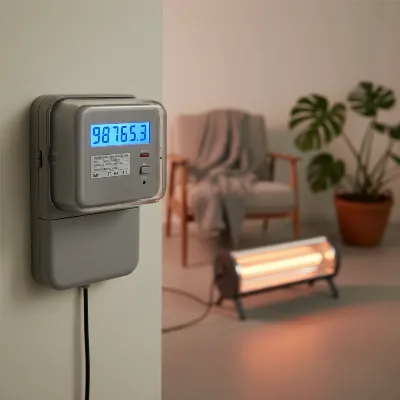 An electricity meter showing high kilowatt-hour usage from a space heater in a home
Strategies to Reduce Space Heater Electricity Use
Minimize electricity consumption without sacrificing comfort:
- Optimize Settings: Use lower wattage settings (e.g., 750W) to cut energy consumption by half. Engage “eco” mode if available for automatic power adjustment.
- Leverage Thermostats and Timers: Choose heaters with adjustable thermostats to prevent continuous operation. Programmable timers ensure the heater runs only when needed, avoiding heating unoccupied spaces.
- Match Heater Size to Room: Use an appropriately sized heater for efficient warming. A general guideline is 10 watts per square foot; a 1,500-watt heater suits spaces up to 150 square feet.
- Improve Home Insulation: Seal drafts around windows and doors with weatherstripping or caulk. Close curtains or blinds at night for added insulation, reducing heater runtime.
- Practice Zone Heating: Use space heaters for “zone heating”—warming only occupied rooms. Lower your central thermostat by 7-10 degrees and use a space heater in your immediate vicinity for significant savings.
Essential Safety Considerations for Space Heaters
Safety is paramount when using space heaters:
- Placement: Place heaters on a level, non-flammable surface, at least three feet away from flammable items like curtains, furniture, and bedding. Avoid high-traffic areas.
- Overheat Protection and Tip-Over Switches: Select models with automatic shut-off features. Overheat protection turns the heater off if it gets too hot, and a tip-over switch deactivates it if it falls.
- Plug into Wall Outlets: Always plug space heaters directly into a dedicated wall outlet. Never use extension cords or power strips, as they can overload and cause fires.
- Supervision: Never leave a space heater unattended, especially with children or pets present. Turn off and unplug the heater when leaving the room or going to sleep.
- Regular Inspection: Periodically check the heater’s cord and plug for damage, fraying, or discoloration. Discontinue use immediately if any issues are found.
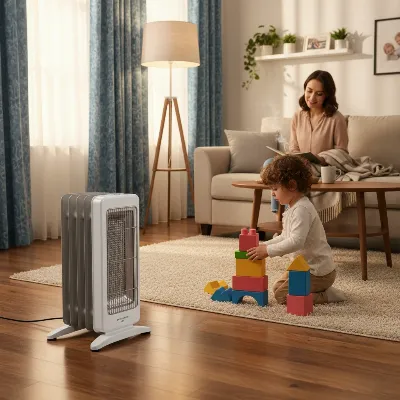 A family safely using a space heater with safety features like a tip-over switch, away from curtains and children
Conclusion
Understanding how much electricity a space heater uses per hour is the first step toward efficient and economical heating. With typical models drawing between 750 and 1,500 watts, these devices can add $0.12 to $0.25 to your electricity bill for every hour of operation, depending on your local rates. By recognizing the impact of wattage, room size, insulation, and thermostat use, you gain control over your energy consumption. Implementing smart strategies like using lower settings, leveraging thermostats and timers, and practicing zone heating can significantly reduce running costs while keeping your living spaces comfortably warm. Always prioritize safety, ensuring your space heater is properly placed and equipped with essential safety features.
Are you ready to make informed decisions about your home’s heating this winter?
Frequently Asked Questions
Do space heaters use more electricity than central heating?
|
Our Picks for the Best Space Heater in 2026
As an Amazon Associate I earn from qualifying purchases.
|
||
| Num | Product | Action |
|---|---|---|
| 1 | DREO Space Heater, 1500W Electric Heaters for Indoor Use with Thermostat, 70° Oscillation, 8 Safety Protections, 5 Modes, Remote, 12H Timer, Quiet Portable Heater for Office, Bedroom, Large Room |

|
| 2 | DREO Quiet Space Heater, 1500W Portable Heaters for Indoor Use with Remote, 70° Oscillation, Fast and Safety Electric PTC Ceramic for Desk Office Bedroom, 12H Timer |
|
| 3 | DREO Space Heater Indoor, 25" 11.5ft/s Fast Portable Room Heater with Remote and Thermostat, 3 Modes, Overheating & Tip-Over Protection, Electric Heaters for Indoor Use Large Room, Bedroom, Gold |
|
| 4 | DREO Space Heater for Large Room, 23 Inch Electric Heaters for Indoor Use, 8 Safe Protection Tower, 70° Oscillation, PTC Ceramic with Thermostat and Remote, Quiet, 12H Timer, Bedroom, Office |
|
| 5 | DREO Atom One Space Heater with Remote, 70°Oscillating Electric Heaters with Digital Thermostat, 1500W PTC Ceramic Heater, 12h Timer, Quiet Safety Heating, Portable Heater for Home Office |
|
| 6 | DREO Space Heater, Portable Electric Heaters for Indoor Use with Thermostat and Remote, 2024 Upgraded, Digital Display, 12H Timer, 5 Mode, 1500W PTC Ceramic Fast Safety Heat for Office Bedroom Home |
|
| 7 | Dr Infrared Heater DR-968 Portable Space Heater, 1500-Watt, Cherry |
|
| 8 | Dreo Space Heater 1500W, 60° Adjustable Tilt, 10.5ft/s Portable Electric Heaters for Indoor Use with Thermostat, 8 Safety Protections, 3 Modes, Remote, Quiet Desk Heater for Bedroom, Office, Black |
|
| 9 | DREO Space Heater, 1500W Portable Electric Heaters for Indoor Use, PTC Ceramic Heater for Office with Remote, Thermostat, 70°Oscillation, 12H Timer, 5 Modes, Safe Quiet Room Heater for Bedroom |
|
| 10 | DREO Space Heater, Portable Electric Heaters for Indoor Use with Thermostat and Remote, 2024 Upgraded, Digital Display, 12H Timer, 5 Mode, 1500W PTC Ceramic Fast Safety Heat for Office Bedroom Home |
|
Space heaters can be more cost-effective than central heating if you are only warming one or two occupied rooms and keeping your central thermostat lower. However, heating multiple rooms with several space heaters can quickly become more expensive than using a central heating system, which is generally more efficient for heating an entire home.
How can I calculate the exact cost of my space heater?
To calculate the exact cost, find your heater’s wattage (W) on its label. Divide this by 1,000 to get kilowatts (kW). Multiply the kW by the number of hours you use it, then multiply that by your electricity rate per kilowatt-hour (kWh), which can be found on your utility bill. For example, a 1,500W heater (1.5 kW) used for 4 hours at $0.15/kWh would cost 1.5 kW * 4 hours * $0.15/kWh = $0.90.

I’ve been using a 750-watt model for my bedroom, and it’s good for taking the chill off. Knowing it only costs around $0.12 per hour makes me feel better about leaving it on for a few hours before bed. It’s definitely more efficient than trying to heat the whole house when I’m just in one room.
I have a smaller personal heater, probably in the 200-500 watt range, and while it’s cheap to run, it doesn’t really heat up my space enough. It’s fine if I’m sitting right next to it, but I was hoping for a bit more warmth for my small craft room. I might need to upgrade to something a bit more powerful next winter.
I always wondered how much my little space heater was actually costing me. This breakdown of 1,500-watt heaters using about $0.20 to $0.25 per hour was super helpful. Now I feel much better about running it in my home office without getting a huge surprise on my electric bill. It’s great for just warming up my immediate area.
This info on converting watts to kilowatt-hours was exactly what I needed. I’m pretty good at tracking my energy use, and understanding how utility companies charge by kWh helps me pick the right heater. My 1.5 kW heater keeps my living room cozy without breaking the bank, especially now that I know the hourly cost.