The top 5 best propane space heaters for garage workshops include the Mr. Heater Big Buddy, Mr. Heater 125,000 BTU Forced Air, Heat Hog 9,000 BTU, DeWalt 68,000 BTU Forced Air, and InoKraft Maxheat MH125. These heaters are selected based on their performance, reliability, and safety features, offering solutions for various garage sizes and heating needs, from portable radiant warmth to powerful forced-air heating for large spaces.
Choosing the Right Space Heater for Your Garage Workshop
Selecting an ideal propane space heater for your garage workshop involves balancing heating capacity with portability, fuel efficiency, and essential safety considerations. The right unit ensures comfort without compromising your well-being or your tools.
Types of Propane Space Heaters
Propane heaters for garages typically fall into two main categories based on their heating technology: For expert reviews reviews on this site.
- Forced Air Propane Heaters: These heaters use a fan to aggressively distribute heated air throughout a large space. They are known for their ability to rapidly warm up extensive areas, making them ideal for quickly transforming a frigid garage into a comfortable environment. However, their fans often generate significant noise.
- Radiant/Convection Propane Heaters: Radiant heaters work by emitting infrared radiation that directly warms objects and people in its path, much like sunlight. This makes them efficient for spot heating or in spaces where doors open frequently, as they don’t primarily heat the air. Convection heaters, on the other hand, warm the air immediately surrounding the unit, which then rises, allowing colder air to sink and be heated, creating a circulation of warmth. They tend to be quieter but take longer to heat an entire space.
Pros and Cons of Each Type
Each propane heater type offers distinct advantages and disadvantages suitable for different workshop needs:
| Feature | Forced Air Propane Heaters | Radiant/Convection Propane Heaters |
|---|---|---|
| Pros | Rapidly heats large areas; excellent for quick warm-ups | Quieter operation; ideal for spot heating; more fuel-efficient for targeted warmth |
| Cons | Can be noisy; requires electricity for the fan; may create “cold spots” if air circulation is poor | Slower to heat an entire space; heat may not feel as pervasive throughout a large area |
| Best Use | Large, poorly insulated garages needing quick, powerful heating | Smaller, better-insulated workshops, or for personal spot heating |
Power Output (BTUs) and Garage Size
The heating power of a propane space heater is measured in British Thermal Units (BTUs). Matching the BTU output to your garage size and insulation level is crucial for effective and efficient heating. A general guideline for gas heaters is to aim for approximately 45 BTUs per square foot of space you intend to heat. For example, a standard two-car garage of about 400-500 square feet might require a heater between 18,000 and 22,500 BTUs. Larger, poorly insulated garages, or those in extremely cold climates, will naturally require significantly more BTUs, potentially upwards of 60,000 to 125,000 BTUs for rapid heating. Always consider your ceiling height as well; higher ceilings mean more volume to heat.
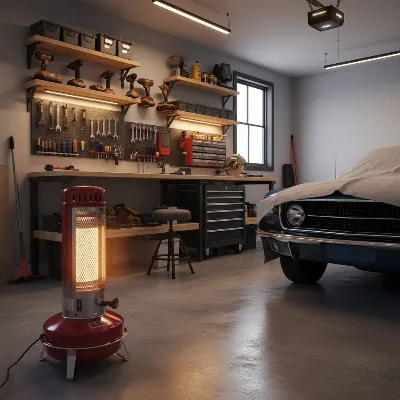 Propane space heater in a well-organized garage workshop with various tools, illustrating adequate space heating for different sizes.
Essential Safety Features
|
Our Picks for the Best Space Heater in 2026
As an Amazon Associate I earn from qualifying purchases.
|
||
| Num | Product | Action |
|---|---|---|
| 1 | Dreo Space Heater 1500W, 60° Adjustable Tilt, 10.5ft/s Portable Electric Heaters for Indoor Use with Thermostat, 8 Safety Protections, 3 Modes, Remote, Quiet Desk Heater for Bedroom, Office, Black |

|
| 2 | DREO Space Heater, Portable Electric Heaters for Indoor Use with Thermostat and Remote, 2024 Upgraded, Digital Display, 12H Timer, 5 Mode, 1500W PTC Ceramic Fast Safety Heat for Office Bedroom Home |
|
| 3 | DREO Space Heater Indoor, 25" 11.5ft/s Fast Portable Room Heater with Remote and Thermostat, 3 Modes, Overheating & Tip-Over Protection, Electric Heaters for Indoor Use Large Room, Bedroom, Gold |
|
| 4 | DREO Space Heater, 1500W Portable Electric Heaters for Indoor Use, PTC Ceramic Heater for Office with Remote, Thermostat, 70°Oscillation, 12H Timer, 5 Modes, Safe Quiet Room Heater for Bedroom |
|
| 5 | DREO Quiet Space Heater, 1500W Portable Heaters for Indoor Use with Remote, 70° Oscillation, Fast and Safety Electric PTC Ceramic for Desk Office Bedroom, 12H Timer |
|
| 6 | DREO Atom One Space Heater with Remote, 70°Oscillating Electric Heaters with Digital Thermostat, 1500W PTC Ceramic Heater, 12h Timer, Quiet Safety Heating, Portable Heater for Home Office |
|
| 7 | DREO Space Heater for Large Room, 23 Inch Electric Heaters for Indoor Use, 8 Safe Protection Tower, 70° Oscillation, PTC Ceramic with Thermostat and Remote, Quiet, 12H Timer, Bedroom, Office |
|
| 8 | DREO Space Heater, 1500W Electric Heaters for Indoor Use with Thermostat, 70° Oscillation, 8 Safety Protections, 5 Modes, Remote, 12H Timer, Quiet Portable Heater for Office, Bedroom, Large Room |
|
| 9 | DREO Space Heater, Portable Electric Heaters for Indoor Use with Thermostat and Remote, 2024 Upgraded, Digital Display, 12H Timer, 5 Mode, 1500W PTC Ceramic Fast Safety Heat for Office Bedroom Home |
|
| 10 | Dr Infrared Heater DR-968 Portable Space Heater, 1500-Watt, Cherry |
|
Safety is paramount when operating any propane heater in an enclosed space like a garage. Modern propane heaters come equipped with critical safety features designed to prevent accidents:
- Oxygen Depletion Sensors (ODS): This sensor automatically shuts off the heater if oxygen levels in the room drop to unsafe levels, mitigating the risk of carbon monoxide poisoning.
- Tip-Over Protection: Should the heater be accidentally knocked over, a tip-over switch will immediately cut off the fuel supply, preventing fire hazards.
- Overheat Shutoff: This feature turns off the heater if it reaches an unsafe internal temperature, protecting against overheating and potential fire.
- CSA/UL Certification: Always look for heaters certified by recognized safety organizations like CSA (Canadian Standards Association) or UL (Underwriters Laboratories). These certifications indicate that the product has met rigorous safety standards.
- Carbon Monoxide Detectors: Beyond the built-in safety features, installing a separate, battery-operated carbon monoxide detector in your garage is a non-negotiable safety measure. It provides an independent warning system for this odorless, colorless, and deadly gas.
- Proper Ventilation: Regardless of built-in safety features, adequate ventilation is essential. Always ensure a window or garage door is cracked open slightly when operating a propane heater to allow for fresh air circulation and prevent byproduct accumulation. Using the heater on a non-combustible surface and keeping it away from flammable materials are also crucial practices.
Top 5 Best Propane Space Heaters for Garage Workshops
When it comes to warming your garage workshop, certain propane heaters consistently rise to the top for their performance, reliability, and user-friendly features.
1. Mr. Heater Big Buddy
The Mr. Heater Big Buddy is a versatile and popular choice for its balance of portability and heating power, capable of warming spaces up to 450 square feet. It runs on 1-pound propane cylinders or can be connected to a larger tank with an optional hose. Its radiant heating technology offers quiet warmth, making it suitable for focused work. Crucially, it includes an Oxygen Depletion Sensor (ODS) and a tip-over switch for enhanced safety, making it a reliable option for many garage enthusiasts.
2. Mr. Heater 125,000 BTU Forced Air Propane Heater
For those with larger garages or a need for rapid, high-output heating, the Mr. Heater 125,000 BTU Forced Air Propane Heater is a powerhouse. This unit can quickly raise temperatures in spaces exceeding 1,000 square feet, transforming freezing environments into comfortable workshops in minutes. Its forced-air design aggressively distributes heat, eliminating cold spots. While it requires an electrical outlet for its fan and ignition, its sheer heating capacity makes it ideal for substantial warming tasks, though it can be noisy during operation.
3. Heat Hog 9,000 BTU Propane Heater
The Heat Hog 9,000 BTU Propane Heater stands out as a strong contender, particularly for those who appreciate portability and directional heating. Similar to the Big Buddy, it runs on 1-pound propane tanks (or larger tanks with an adapter) and provides efficient warmth for areas up to 225-250 square feet. A unique feature is its tilting capability, allowing users to direct heat precisely where it’s needed. It also comes equipped with essential safety features like tip-over and oxygen-depletion sensors, offering peace of mind. An 18,000 BTU version is also available for larger spaces up to 500 square feet.
4. DeWalt 68,000 BTU Forced Air Propane Heater
The DeWalt 68,000 BTU Forced Air Propane Heater is built for tough workshop environments, offering robust and quick heating for large garages. Its powerful forced-air output can effectively warm a two-car garage (around 360 square feet) with ease and can tackle even larger spaces. Assembly is minimal, usually just attaching a handle, and it connects to a standard propane source and electrical outlet (or battery for ignition and fan). This heater is an excellent choice for those needing reliable, rapid heat in demanding conditions.
5. InoKraft Maxheat MH125 Forced Air Propane Heater
The InoKraft Maxheat MH125 is a 125,000 BTU forced-air unit that excels with a built-in thermostat, a feature that significantly enhances user convenience. This heater cycles on and off to maintain a set temperature between 25°F to 95°F, eliminating the need for constant manual adjustments. It’s capable of heating large semi-insulated workspaces quickly and maintaining consistent warmth, making it ideal for longer work sessions where steady temperature is desired. The inclusion of a regulated hose and straightforward setup adds to its appeal.
Comparing Top Models
Here’s a quick comparison of the highlighted propane space heaters:
| Model | Type | Max BTU Output | Max Sq. Ft. Coverage | Key Features |
|---|---|---|---|---|
| Mr. Heater Big Buddy | Radiant | 18,000 | 450 | Portable, quiet, ODS, tip-over switch |
| Mr. Heater 125,000 BTU Forced Air | Forced Air | 125,000 | 1,000+ | Rapid heating, high output, aggressive heat distribution |
| Heat Hog 9,000 BTU | Radiant | 9,000 | 250 | Portable, tilting head for directional heat, ODS, tip-over |
| DeWalt 68,000 BTU Forced Air | Forced Air | 68,000 | ~700-1000 | Robust, quick heating, easy setup |
| InoKraft Maxheat MH125 | Forced Air | 125,000 | 3,200 | Built-in thermostat, consistent temperature control |
Guide to Buying Your Propane Space Heater
Purchasing a propane space heater involves more than just picking a powerful unit. Consider these factors to ensure your investment perfectly matches your needs:
- Budget: Propane heaters range widely in price. Determine how much you’re willing to spend, keeping in mind that higher BTU models with advanced features typically cost more upfront.
- Usage Needs:
- Portability vs. Fixed Installation: Do you need a heater that can be moved easily around the garage or even to different job sites, or do you prefer a stationary unit? Portable models are common, but some heavy-duty forced-air heaters are best placed in a consistent location.
- Primary vs. Supplemental Heating: Are you relying on the propane heater as the sole heat source for your garage, or is it meant to supplement existing heating or provide quick warmth for short tasks? This will influence the required BTU output.
- Ventilation Requirements: All propane heaters require proper ventilation to prevent carbon monoxide buildup. Some models are “vent-free” but still necessitate a cracked window or door for fresh air, while others (especially high-BTU forced-air units) might require more substantial airflow. Always read the manufacturer’s instructions carefully regarding ventilation.
> “The most common mistake people make with garage heaters is underestimating the BTU needs for their space, or neglecting proper ventilation. Always size up if in doubt, and prioritize airflow for safety.” – Johnathan Davis, Certified HVAC Technician and Workshop Expert
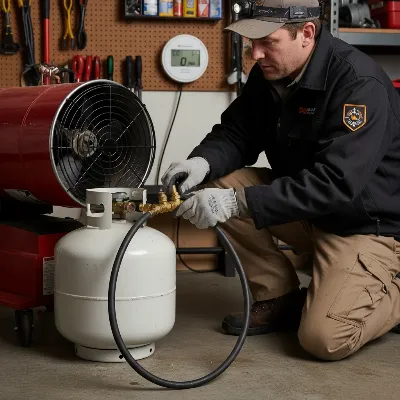 A technician inspecting a propane space heater in a garage, emphasizing safety checks and proper connections.
Conclusion
Choosing the ideal propane space heater for your garage workshop is an investment in comfort and productivity. Whether you opt for the portable versatility of a Mr. Heater Big Buddy, the robust heating power of a Mr. Heater 125,000 BTU forced air unit, or the smart thermostatic control of an InoKraft Maxheat MH125, the key is to match the heater’s capabilities with your specific needs. Prioritizing safety features like ODS and tip-over protection, ensuring proper ventilation, and accurately sizing the unit for your space will ensure a warm, safe, and efficient environment. Don’t let the cold halt your projects; empower your workshop with the right propane heater. Which model will help you keep those winter projects rolling?
Frequently Asked Questions
How do I calculate the right BTU for my garage workshop?
A good rule of thumb for gas heaters is to aim for approximately 45 BTUs per square foot of space. Measure your garage’s length and width to get the square footage, then multiply that by 45. For poorly insulated garages or extremely cold climates, consider increasing this estimate slightly or opting for a higher BTU range within your calculated need.
Are vent-free propane heaters safe for indoor use in a garage?
While “vent-free” propane heaters are designed with advanced safety features like Oxygen Depletion Sensors (ODS), it is still crucial to provide adequate ventilation when using them in a garage. This means always keeping a window or the garage door slightly ajar to allow for fresh air circulation and prevent the buildup of combustion byproducts, including carbon monoxide.
Can I use my indoor propane heater with a large propane tank?
Many portable indoor propane heaters are designed to operate with 1-pound propane cylinders but can be adapted for use with larger 20-pound (or more) propane tanks. This typically requires a separate hose and filter accessory, which often needs to be purchased additionally. Always ensure the adapter hose is compatible and properly installed according to manufacturer instructions.
What are the main types of propane heaters for garages?
Propane heaters for garages primarily come in two types: forced air and radiant/convection. Forced air heaters rapidly distribute heat with a fan, ideal for large, cold spaces, while radiant heaters directly warm objects and people, suitable for spot heating or smaller, better-insulated workshops.
What are the essential safety features for a propane garage heater?
Essential safety features for a propane garage heater include Oxygen Depletion Sensors (ODS), tip-over protection, overheat shutoff, and CSA/UL certification. Always use a separate carbon monoxide detector and ensure proper ventilation by cracking a window or door.
How do forced air and radiant propane heaters differ in operation?
Forced air propane heaters use a fan to quickly circulate heated air throughout a large area, making them effective for rapid whole-space warming but often noisy. Radiant heaters emit infrared radiation that directly warms objects and people, providing quieter, more targeted heat ideal for spot warming or smaller, well-insulated spaces.

I picked up the Mr. Heater Big Buddy for my small two-car garage, and it’s been a game-changer. It heats up the space quickly, even on really cold mornings, and I love how portable it is. I can easily move it around wherever I’m working, and it’s super reliable. Definitely recommend it for anyone needing a quick heat source.
The DeWalt 68,000 BTU Forced Air heater is a beast! My workshop is pretty large, and this thing gets it toasty in no time. It’s a bit louder than I expected, but for the amount of heat it puts out, I can live with it. Great for those big projects when you need serious warmth.
I got the Heat Hog 9,000 BTU for my smaller shed, and while it does the job, I wish it had a longer run time on a single tank. It’s good for quick bursts of heat, but if I’m out there for a few hours, I find myself swapping tanks more often than I’d like. It’s compact though, which is a plus.
The InoKraft Maxheat MH125 has been fantastic for my detached garage. I was looking for something with powerful forced-air heating, and this delivered. It’s really efficient with fuel, which is a big plus, and the safety features give me peace of mind. No more freezing while I’m trying to work on my car!